Analyzing the report
- 1.11. This Report sets out a new ambition for the country: a generational promise that every young person will be guaranteed the opportunity to earn or learn.
- 4. In the period between, my team and I have engaged extensively in the search for ways to solve the UK’s NEET crisis. With employers and educators; charities and community groups; national, regional and local politicians; and, most importantly, with young people themselves. We have scoured the world to understand what we can learn from other countries. We have undertaken new research and new polling. We have worked with Government departments to ensure the changes we propose are deliverable and fiscally responsible.
- 6. These deliberations have brought me to some clear conclusions. Our country is at a fork in the road. Go on as we are and see the NEET crisis grow. Or change course and make the difficult changes that can shift the trajectory. This is a moment of choice for the country. Half measures will not do. The country has had no shortage of schemes, pilots and initiatives for young people. Many have helped those they reached, but they have not prevented nearly one million young people – one in eight – from being out of education and employment.2 Most are economically inactive rather than looking for work.3 Six in ten have never had a job.4 Today’s NEET crisis is no longer the old story of a temporary cycle of youth unemployment. It is a new phenomenon of youth detachment.
- 9. It shows up in the numbers. Across Europe, only Romania has higher NEET rates than the UK.6 Compared to the countries of northern Europe with lower rates, we have chosen to invest far less in support to get young people into education or employment. We are used to hearing well-founded arguments about the need to invest more in physical capital to grow our economy: in infrastructure and energy, defence and digitalisation. We need to apply the same logic to investing in human capital. And to do so for the long term.
- 10. Without a sharp change in direction, the country will pay an ever higher economic price through lost skills, lower productivity and slower growth. In this Report, we set out how higher youth participation could contribute over 0.4 per cent of additional GDP per year.7
- 12. Above all, without change, the greatest price will be paid by young people themselves: in lost life chances, lost opportunities, lost earnings, lost confidence and lost purpose. Fundamentally, the NEET crisis is a moral problem, with dire economic and fiscal consequences.
- 13. This is not simply a cause for young people. It is a cause for the country. Demographic change makes it a necessity. If the needs of an ageing society are to be met, as many young people as possible have to become a net contributor by working and paying their taxes in order to fund the public services on which older generations particularly rely. Britain’s future relies on us backing young people. They are the next generation of workers, parents, taxpayers, entrepreneurs, carers and public servants. Helping them succeed is in all of our interests.
- 15. The labour market of the next decade will look different from the labour market of the last. The pace of change is electrifying. That means what the State does - in education, skills, welfare and health - has to change too, and at pace. We cannot future-proof particular occupations. We can future-proof young people, through changes to the education and skills system in particular. It should prepare young people for a world in which adaptability is no longer a luxury, but a condition of security.
- 16. The response to the Interim Report has convinced me that there is a visceral mood for change in the country. Families feel it. Employers feel it. Politicians feel it too. They all know that the risk of a lost generation of young people is real, and more importantly they want to do something about it. This generational challenge calls for a different generational choice: to put young people first. They must be the priority for policy and action.
- 17. That will require the nation to commit resources. Some can come from welfare savings as young people move into work. But crude benefit cuts will not work. If young people are plunged into destitution, costs to the taxpayer simply show up elsewhere in the system – in homelessness, health and crime. What is needed instead is upfront investment in more opportunities for young people to earn or learn and in the practical support to enable them to do so. Investment first, payback later. That is the only sustainable way of improving life chances and reducing costs.
- 21. Third, the health system is organised around diagnosing and treating illness once it has taken hold rather than identifying risk, preventing problems from escalating and keeping young people participating in education or employment. That matters when poor health, particularly mental ill health, has become one of the defining causes of youth economic inactivity.
- 22. Fourth, the welfare system asks the wrong question of young people: what can’t you do, rather than what could you do? It takes too many young people into a lifetime on benefits rather than into work – with ruinous consequences for their life chances. Poverty and inequality are at the core of the NEET crisis: rates are highest where disadvantage is greatest.9 But the benefits system plunges too many young people into more poverty rather than seeking to end it. It too often becomes a trap rather than a springboard.
- 26. It advocates for a new young people-first approach both to public policy and employer practice. It proposes not just new investments and new policies but new laws and new institutions so that there is a permanent platform on which change can be built. Recent history is littered with periodic attempts to address the NEET crisis but there has been no sustained and systematic effort to eradicate the problem for good. This Report sets out how we can change that. It does so by identifying the systemic changes that are needed across education, health, welfare and labour market policy. It echoes the Prime Minister’s call for a Rewiring of the State by showing how employers and educators, mayors and councils, families and communities can contribute to delivering full employment and education for young people.10
- 28. The twin beliefs at the heart of this Report are that work gives shape, meaning and purpose to young lives, and that every young person has something to contribute.
- 30. I believe we should set ourselves a new national ambition: every young person should be learning, earning or actively participating. By 2036, the United Kingdom should aim to reduce the NEET rate to around 5 per cent and become one of Europe's best-performing countries for youth participation. That will be an effective rate of NEET Zero. Full youth participation. Full employment and full education for the young. The end of long-term youth unemployment.
- 32. Achieving full youth participation means recognising that the NEET population is not uniform. It consists of nearly one million very different young people. Those who are disabled face particular challenges. So too do many young people from an ethnic minority background. Some young people who are NEET are close to being able to work and are being held back by a lack of experience or a practical barrier such as transport. Others need help with qualifications, confidence, housing, caring responsibilities or mental health. Some disabled young people will require intensive and sustained support. A smaller group will require secure long-term protection because conventional participation is not a realistic expectation.
- 58. This Report is not only about reducing the current stock of young people who are NEET. It is about preventing young people becoming NEET in future. The key to that is an education system that equips young people for the future world of work – and one that takes prevention seriously. Education should be the strongest bridge between childhood and adult working life. For many young people it is. Britain has much to be proud of in its schools, colleges and universities. But the world of work is changing faster than the world of education. Schools focus strongly on academic results, but not enough on readiness for work. Britain is a world 13 leader in higher education but a laggard in vocational education. Apprenticeships and further education remain woefully under-supplied compared with countries that achieve lower NEET rates. A new balance is needed: preventing risk earlier, putting aptitudes alongside knowledge, and making Britain a powerhouse in technical education as well as academic education.
- 77. Rather than helping young people access help quickly to enable them into employment or participation the diagnose-wait-treat model leads to many waiting, not working and ending up on welfare. Once they are in the benefits system it becomes hard to get out. Poor mental or physical health should not become a one- way route out of education and work.
- 94. For most young people, welfare should be a route to work, not a destination. Too often the present system does the opposite. It writes a cheque but not a plan. It asks a young person what they cannot do before it asks them what, with the right support, they could. And once a young person enters the health-related benefit system, all too often it becomes very hard to leave.
- 109. We expect those with conditions such as anxiety, depression, ADHD and autism - who currently form the majority of new PIP claimants - should be particular beneficiaries. In the current system, young people with these conditions often end up trapped on benefits, when under the new system they would be both expected and enabled to be in work.
- 110. These changes will not be easy to make. Nor will they be pain-free. They could mean some people get less financial support at the beginning of their benefit claim than under the current system. But the approach I have taken is to try to define what would give young people the best chance of building a good life, not just over a year or two but over the course of their lifetimes - under the current system a 24-year-old young person who has been NEET for six years could lose up to £300,000 in lifetime earnings even if they re-enter the labour market.34
- 111. The modelling carried out for this Review shows that these reforms are expected to help around 440,000 young people into sustained work by 2036. When the impacts of my reforms are considered together the net incomes of young people are expected to rise by over £2 billion and relative poverty after housing costs is estimated to fall by 50,000.35
- 113. Welfare savings begin in 2029/30. They continue so that by 2036/37 they cumulatively reach £13.7 billion.
- 135. Failure to address high NEET rates is already costing the country around £125 billion a year. The fiscal cost alone is almost £22 billion. 47 Standing still imposes a high and rising fiscal burden.
- 136. The choice is not whether we spend more money, but on what. Currently, we are spending more on keeping young people inactive and on benefits. My proposals are about spending money on enabling young people into participation.
- 140. As upfront investment in enhanced opportunity and support takes effect, savings will start to come from reduced spending on benefits while increased revenues for the public purse will flow from more people being in work and paying their taxes. The positive fiscal impact increases with sustained growth in young people’s participation rates until the package achieves fiscal savings in 2036/37.48
- 190. Health is now central to the NEET crisis. 48 per cent of NEET respondents reported a long-term health condition, compared with 25 per cent of non-NEET respondents. 37 per cent said their NEET status was related to a physical or mental health condition or disability. Among NEET respondents with a long-term condition, 79 per cent said it was one of the reasons they were currently outside work, education or training.69 The issue is not simply how many young people report a health condition. It is how much that condition affects what they can do. Among NEET respondents with a long-term condition, 54 per cent said it reduced their ability to carry out day- to-day activities a lot, compared with 22 per cent of non-NEET respondents with a condition. Across the whole sample, around two in five NEET respondents had a long-term health condition that affected day-to-day activities, compared with around one in five of their non-NEET peers. Among the small group who did not expect to move into work, education or training now or in the future, health was by far the most common reason, cited by 73 per cent.70 Seen over time, it is obvious how far health and participation have become intertwined.
- 213. Our online survey is equally clear about what young people say is missing now. 52 per cent wanted help finding suitable jobs, courses or training. 37 per cent wanted help building skills or experience. 28 per cent wanted support that took account of their circumstances, including health conditions or caring responsibilities.113 Only 42 per cent of NEET respondents said they had received support from family or carers to move towards work or learning, compared with 56 per cent of non-NEET respondents. For education providers the figures were 22 per cent and 42 per cent; for friends and peers, 24 per cent and 33 per cent.114 By contrast, 28 per cent of NEET respondents reported support from Jobcentre Plus or a work coach, compared with 8 per cent of non-NEET respondents. 14 per cent said they had received no support at all.115
- 216. None of this is to argue that young people do not have personal responsibility to make the best of things. Effort matters. Attendance matters. Behaviour matters. Young people have agency and obligations. But it is dishonest to pretend that individual effort alone can overcome a labour market with too few first rungs, an education system that can lose sight of what happens after the qualification, health problems that interrupt the transition into adulthood, a benefit system that becomes a trap instead of a springboard and services that stop and start at institutional boundaries.
- 276. In the future, support should follow the young person rather than their benefit status. The existing £3,000 payment should remain the core grant. Each employer hiring a young person who is aged between 16 and 24 and has been NEET for six months would receive that amount to help with costs. In addition, an employer taking on somebody facing substantially greater barriers, including a care leaver, a young person leaving custody, a young parent or a disabled young person who needs significant additional support would receive a new extra premium of £2,000. A business with fewer than 50 employees would receive a further new small business premium of £2,000. The principle is that the further a young person is from the labour market, and the more managed risk an employer is being asked to take, the more government financial support follows.
- 354. Education should be the strongest bridge between childhood and adult working life. For many young people it is. Britain has much to be proud of in its schools, colleges and universities. Standards have risen, there are outstanding teachers and lecturers, and good qualifications remain one of the strongest protections a young person can have against unemployment and economic inactivity later in life.206 The reforms proposed in this chapter start from those strengths, but recognise that they are not enough to provide a sustainable route for young people to thrive in the future.
- 355. The world of work is changing faster than the world of education. While good GCSE attainment significantly reduces the risk of becoming NEET, young people with higher qualifications are not immune to this risk. 207 Nearly a third of NEET young people have GCSEs as their highest qualification. 208 One in seven have a university degree or equivalent. 209 Without change, the education system will become increasingly outdated for too many young people as advances in technology change the nature of work.
- 356. A young person entering working life today is unlikely to acquire one set of skills and rely on them unchanged throughout a forty or fifty-year career. 210 Knowledge matters, but so does the ability to apply it, communicate, work with others, solve problems and continue learning. Agility and adaptability will be essential if the next generation is to participate successfully and sustainably in the labour market of the future.
- 362. This Review is concerned with preparing young people for adult working life. But that cannot mean turning childhood into an ever-earlier rehearsal for work. Childhood has value in its own right. Children need time and space to read, play, make friends, take part in sport, music and the arts, explore interests, take reasonable risks and learn how to relate to other people. Many of the capabilities employers later say they value grow from those experiences. 216
- 364. Schools have a key role here. A knowledge-rich education should sit alongside sport, arts, enrichment, outdoor activity, strong relationships and 80 opportunities for young people to discover interests and aptitudes. That is a vital part of giving young people the foundations from which high standards and successful adult lives can grow. Preparing young people well for adulthood begins with allowing them to have a childhood.
- 366. In the 2025 OECD PISA assessment, England was the second highest performing country in the world outside of East and Southeast Asia.217 A decades long focus on school standards has delivered excellent results. This is a considerable achievement and should be celebrated. Yet this Review has heard how our education and skills system is failing to provide too many young people with the foundations they need to succeed. Both things can be true. Good foundations have been built, but the sands of change are shifting beneath our feet.
- 404. Modern parenting also means setting boundaries in a digital environment that previous generations did not have to face. I fully support the Government’s goal to restrict access to social media for under 16s and create additional protections for 16 to 17 year-olds.292 These restrictions on their own will not address online harms but they can begin to create a generational shift to make unfettered access to social media for children a thing of the past. Restrictions will never remove the need for parents to set boundaries around devices, sleep and online use. As the Australian example shows, this will not be a silver bullet, but if the ban creates the conditions where children turning ten or eleven no longer create social media accounts as a rite of passage, the legislation will have shown its worth. 293 I welcome the Government’s decision to strengthen its guidance so that schools move beyond a ‘not seen, not heard’ approach and ensure that mobile phones are genuinely inaccessible throughout the school day. This is a sensible step given the risks that unrestricted phone access poses to attention, engagement and relationships in school. The policy should be kept under review to ensure it is delivering on the goal of making schools phone free.
- 405. Parents should also be brought more routinely into careers and progression discussions from age 14 onwards. We need to go further than simply sharing information with them. 294 Technical education, FE, apprenticeships, T levels, V levels and higher technical learning will struggle to achieve equal status while the adults influencing young people's decisions understand the academic route far better than the alternatives. Government should therefore ensure easy access to information, available digitally, for both young people and their parents to understand which education and training courses produce the best employment outcomes.
- 407. Every pupil at material risk of disengagement should be known by an adult in the school who understands their circumstances sufficiently to notice significant change. This does not require another new profession. It may be a form tutor, teacher, pastoral lead or another appropriate member of staff. They should be somebody's responsibility.
- 432. Exposure to the world of work should be built across the school journey. In primary school, the purpose should be to broaden horizons and challenge occupational stereotypes rather than ask children to choose careers. During key stage 3, young people should accumulate meaningful exposure through employer projects, workplace visits, talks, enterprise activity and FE and apprenticeship tasters. By key stage 4 every young person who is able to, should experience a real workplace, normally including a substantial placement.
- 553. For young people who are already NEET, the Youth Opportunity Service (YOS) will provide a direct route into health and participation support. There will be a range of health support available through the YOS, covering both physical and mental health needs. The participation principle should apply across health. Physical illness, chronic pain, obesity, respiratory conditions, addiction and other long-term conditions can also interrupt education and work. In particular rapid access to needs-based mental health support will sit at the core of what the YOS does to enable young people into learning or earning. The mental wellbeing and mental health support services outlined below will be a core part of the Support Guarantee that the YOS will be tasked to help young people access. They will be available to those who are NEET or at risk of becoming so who need them from the outset of their interaction with their local YOS.
- 557. Within four weeks the young person will have their own Participation Plan drawn up with their adviser. If they have a health need the Plan will identify how it will be addressed. It will allow their adviser to start turning digital recommendations into practical action: booking an appointment, connecting the young person to an Early Support Hub, arranging vocational rehabilitation.
- 562. Young people will also have access to a proportionate course of brief, evidence- based in-person psychological interventions or counselling where that is needed. This will include advice and strategies for young people experiencing difficulties associated with possible or diagnosed ADHD or autism, including planning, organisation, managing sensory demands, communication, transitions and everyday functioning. Depending on the young person’s needs, support could be delivered by a counsellor, therapist, psychologist, wellbeing practitioner, peer support worker or youth worker, with relevant expertise on neurodevelopmental needs. More tailored support and specialist expertise, including occupational therapy and speech and language therapy, should also be available where needs are more complex, difficulties persist or initial interventions are insufficient. Delivery should build on existing services and shared specialist capacity, rather 133 than creating new standalone teams or assuming everyone requires an individual assessment.
- 564. IPS is an evidence-based supported employment model, originally developed for people with severe and enduring mental health conditions.437 The core approach is a personalised employment goal, a rapid job search, competitive and paid employment, with ongoing individual support to retain that job. Evidence has long shown that IPS improves employment outcomes for people with severe mental illnesses such as schizophrenia and bipolar disorder. 438 Increasingly, evidence also shows that it works for people with common mental health problems, substance- use disorders and alcohol-use disorders. 439 There is emerging evidence that the model works for people with physical health conditions, autism, ADHD, experience of homelessness or experience of the justice system. In short, it is a model that works for the conditions many NEET young people have and should be available through their local YOS.
- 567. More broadly there is a need to reimagine young people’s mental health services. The current care model is not working. Built for people with serious and often enduring mental illness, it too often waits for problems to become sufficiently 135 serious to trigger a clinical response. By then, a young person may already be struggling at school, withdrawing from friends, losing confidence or falling out of work. If the pipeline of young people at risk of becoming NEET is to be reduced, then needs should be identified earlier and support provided at the level of intensity each young person needs.
- 574. This digital open access model should be complemented by much more proactive identification of need. Advances in AI and predictive analytics make it easier to identify the risk of a young person developing health and participation challenges well in advance. The NHS should explore how it can use the Single Patient Record to identify young people at risk of developing mental health needs (or disengaging from school) and consider whether an earlier offer of support may be appropriate. For someone at low or moderate risk, that might mean a simple digital intervention or prompt to seek help. For someone at higher risk, it might mean a proactive community response involving health, education and other local services. Need would be established through digital triage, supported by clinical oversight. Predictive tools should support professional judgement, not make decisions about treatment, diagnosis or participation on a young person's behalf – as children’s charity Barnardo’s has recently recommended, these should be complements rather than replacements for human support. 443 This digitally enabled approach should be the default for immediate help for those who need little intervention, 137 while making it possible to concentrate scarce clinical and human capacity on those who need it most.
- 575. For many young people, early identification and digital support may reveal mild-to- moderate needs that require more than just information but do not require clinical treatment. The next step on the support escalator should therefore usually be practical, preventative and non-clinical support. The NHS should not assume that every problem requires an NHS service. Its role should be to make sure that young people can access the intervention most likely to improve their health, wellbeing and participation, wherever that intervention is delivered. This could include support delivered through schools and colleges (for example, help to navigate bullying), workplaces (for example, help with workplace adjustments) or community organisations (for example, help to access volunteering programmes). Many of these interventions should themselves be delivered digitally.
- 577. Some young people will need more than preventative and low-intensity interventions – the next step up on the support escalator should be integrated neighbourhood care. The purpose should be to prevent deterioration, avoid unnecessary referral into specialist services and reduce reliance on emergency care. Core infrastructure should include integrated neighbourhood teams, combining primary care leadership with much of the day-to-day support delivered by mental health workers, youth workers, counsellors, crisis teams and peer experts. Social prescribing should become a core service to provide young people with access to activities and groups that support wellbeing, confidence, belonging and participation, including through sport, creative arts, volunteering, peer support and other community-based opportunities.
- 607. It is time to move responsibility for long-term sickness absence out of general practice. That process should begin in 2027. A new model is already being tested for working-age adults in four ICBs across England. These ICBs are using new multidisciplinary Community Work and Health Teams (CWHTs) to provide better work and health support than the traditional GP-issued fit note. Staffed by a mix of clinical professionals, including occupational therapists, and non-clinical professionals, such as health coaches and employment advisers, CWHTs provide personalised “stay in work” and “return to work” plans to support people experiencing long-term sickness absence. Support includes identifying reasonable 146 adjustments, working with employers, and helping people address health barriers to employment.
- 609. In addition, where an under 25 year-old makes a health-related benefit claim, that should automatically trigger an offer of support through the Youth Opportunity Service which would bring together health support, employment advice, vocational rehabilitation and practical help according to the needs of the individual.
- 620. Large social care employers should also maximise their contribution to youth participation. There is a strong case for doing so. Skills for Care estimates that the sector had 1.59 million filled posts in 2025/26. 459 Its 2024/25 estimates show that only 7 per cent of the workforce was under 25, compared with 11 per cent of the economically active population, while 27 per cent was aged 55 or over. Skills for Care projects that around 410,000 additional posts could be needed by 2040 to keep pace with growth in the population aged over 65. 460
- 682. This range of options means that the new Opportunity Guarantee, as well as offering paid work, education or an apprenticeship, should also provide a rung on the ladder for young people who are not yet ready for those opportunities. Structured volunteering, community work or, where appropriate, cadet activity, for example, will help provide purposeful, time-limited opportunities that build routine, confidence, teamwork, relationships and experience before progression. 166 They offer a stepping stone towards a job but only 6 per cent of NEET young people currently undertake regular volunteering or unpaid work. 506 By contrast, lots of countries across Western Europe operate schemes to connect young people to community service opportunities in their areas. Germany, France and the Netherlands operate voluntary participation programmes that provide young people with structured opportunities to develop skills, gain experience and build confidence as they transition into adulthood.
- 735. We expect those with conditions such as anxiety, depression, ADHD and autism, who currently form the majority of new PIP claimants, will be particular beneficiaries of the new approach. In the current system young people with these conditions routinely end up trapped in economic inactivity, when under the new system they would be both expected and enabled to be in work.
- 739. The modelling carried out for this Review shows that these reforms are expected to help around 440,000 young people into sustained work by 2036. When the impacts of my reforms are considered together the net incomes of young people are expected to rise by over £2 billion and relative poverty after housing costs is estimated to fall by 50,000.517
- 740. The job of the welfare system is to gift young people a future, not simply write a cheque. The conclusion I have reached is that where there is a chance that the right support and right opportunity could change a young person’s life the State should make that the first priority before giving them access to long-term benefits. Of course, the exception to that rule has to be in contributing toward ongoing extra costs where that enables a disabled young person to participate, or when there are young people with profound and long-term disabilities which mean paid work is not realistically possible.
- 742. The reforms outlined in this chapter seek to implement this new approach. In the process they move the needle on the ratio spent on young people between income replacement and employment support. At present for every £25 we spend on benefits we only spend £1 on support.518 As a result of these changes, within the next 10 years that ratio should be £2 to £1. 519 Welfare savings are expected from 2029/30, so that by 2036/37 their cumulative value is £13.7 billion. 520The system I propose will spend less on compensating for economic inactivity, more on creating routes out of it; less on the consequences of failure and more on avoiding it.
- 756. For a small minority of young people, even maximum support will not create a realistic route to participation. This might include, for example, young people with severe or profound and multiple learning disabilities or those whose disability means they require continuous, 24-hour care and support. For them, the proposed new system aims to provide security through a new Severe and Complex Needs Insurance, paying a stable, long-term income set above the maximum benefit rates available today. The aim is to get financial protection in place immediately. It should use clinical, education, care and other evidence the State already holds wherever possible, rather than putting a young person through a lengthy assessment to establish what is already known. As few people as possible should end up on this route. Intentionally it should be a very high bar. But even here, the YOS should not withdraw. People with these kinds of disability are often profoundly, structurally isolated, especially if they lack family or friends to rely on.
- 772. For others, the purpose of the transition will be different. Their needs may still be changing, or the existing system may not provide enough evidence to establish what needs are ongoing and long term and what needs could be better served with support, treatment and opportunity to participate. The transition should give them the space to work with their adviser, explore their choices, take up treatment, employment, functional or practical support and try real opportunities.
- 785. That means accepting an uncomfortable truth. A serious programme of welfare reform for young people may cost more before it saves money. But if it succeeds in increasing employment and reducing long-term dependence, those savings will be more durable than those produced by making crude cuts.
- 786. Around £8.1 billion is already spent each year on key benefits for young people. The wider annual cost of youth disengagement is estimated in my Interim Report at around £125 billion once lost output, scarring, foregone tax, benefits, health and wellbeing are considered.527 So, while these reforms bring with them some upfront costs so does allowing the present course to continue. The difference is that the upfront costs proposed here pay back later.
- 789. We estimate that these reforms will bend the cost curve of spending on youth health and disability benefits. Spending on youth health and disability benefits has risen from £1.7 billion in 2019/20 to £4.7 billion in 2025/26. They are currently forecast to rise again to £8.8 billion in 2036/37. 528 The proposed reforms are expected to lead to annual welfare savings of £3.6 billion in that year. 529 Beyond 2036/37 savings will not only continue. They will grow as more young people move from economic inactivity into work.
- 790.What is more, this is just the tip of a far bigger potential iceberg. While it is true that spending on young people’s health and disability benefits is the fastest growing element of the overall benefits bill, they only account for 13 per cent of total working age claimants.530 The overall bill for disability and incapacity benefits for working age people has risen from £37.7 billion in 2018/19 to £55 billion in 2024/25 – a real- terms rise of 46 per cent.531 They are currently forecast to rise again to £68 billion in 2030/31.
- 792.Welfare change alone cannot solve the NEET crisis. Education must prevent more young people becoming detached and focus more on ensuring young people have the aptitudes and qualifications to navigate the future world of work. Health should stop illness becoming a route into economic inactivity and make participation part of its core mission. Employers should do more to create first chances and change the way they recruit and retain young people. Strategic authorities should have new powers and resources to make the system coherent. But none of this will hold if the welfare system continues to make trying work riskier and standing still on benefits safer.
- 909. The test of this reform is not how many young people pass through a service or how many new structures government creates. It is whether fewer young people become lost to the system, whether those who do are found and helped sooner, and whether most secure and sustain a place in education, training or work. For too long, Britain has managed the consequences of youth detachment after the damage has been done. The purpose of this new settlement is to prevent more of it happening in the first place. A country that expects young people to participate has a responsibility to make participation possible.
- 914. While the intention is to hit the ground running, the speed of change has to be sustained over time. This is a 10 year plan, not a one year sprint. That is deliberate. I could have proposed a faster trajectory but this would not have addressed the underlying structural drivers of rising NEET levels. Short termism has been a constant feature of our country’s approach to this issue over the last 50 years. Spikes of public and political concern have created temporary, sometimes large scale, programmes and investment which then have been removed when the initial crisis passed. We did this in the 1980s, 1990s, during the financial crash and most recently during the COVID-19 pandemic. We have created a myriad of interventions only to turn them off as quickly as we created them.
- 927. Then there is the fiscal cost of nearly one million young people being NEET. The fiscal exposure works through three channels, none of which sits with a single Whitehall department: foregone tax revenue both now and in the future, as youth unemployment leads to lost long-term earnings; growing spending on benefits; and increased health and wider public service costs arising from the consequences of young people not participating. In the Interim Report, we estimated these costs to be £21.6 billion per year.557
- 998. The Welfare State gave security. That promise must endure. But the task now is to add another promise alongside it: that no young person who can participate will be denied the chance to do so because the labour market closed the first door, because public services failed to join up, or because the State asked what they could not do before asking what they might become.
Why is that the ambition
? Why is it necessary for absolutely everyone to earn
their right to live? In specifically the UK, there are 700k vacant jobs and 1.7 million unemployed people. And more will be disappearing without coming back, so by what means do you intend to achieve it, regardless? And by learn
I presume they mean more school torture.
Why exactly is it a crisis?
You keep talking about a crisis but aren't providing proof as to why it is such. And what's the problem with youth detachment
if there is nothing worthwile to attach to?
Human capital
- fuck off psycho. Humans are not capital, but living, feeling, dreaming, suffering beings deserving to fulfill themselves.
So what? All GDP means is how much is produced, bought, and sold. That should not be a measure of a healthy society. You can increase GDP by employing kids, for example. Or producing things that break earlier on purpose.
They will only lose life chances
and opportunities
if that's what is decided. It is not some law of physics that opportunities are related directly to jobs. We could easily redirect all the war spending, space travel spending, and other frivolous spendings towards people who can't or don't want to work (the line between those is blurrier than you'd think). And purpose
? Don't make me laugh. Barely anyone is fulfilled by their jobs. In fact, one of the biggest regrets of the close-to-dead is that they worked too much.
Once again, redirect it from elsewhere. Don't shove everyone into jobs that don't even exist and pretend there are no other possible sources of funding. Also, why do you think you have an ageing society
? Why does no one want to bear kids into this hell?
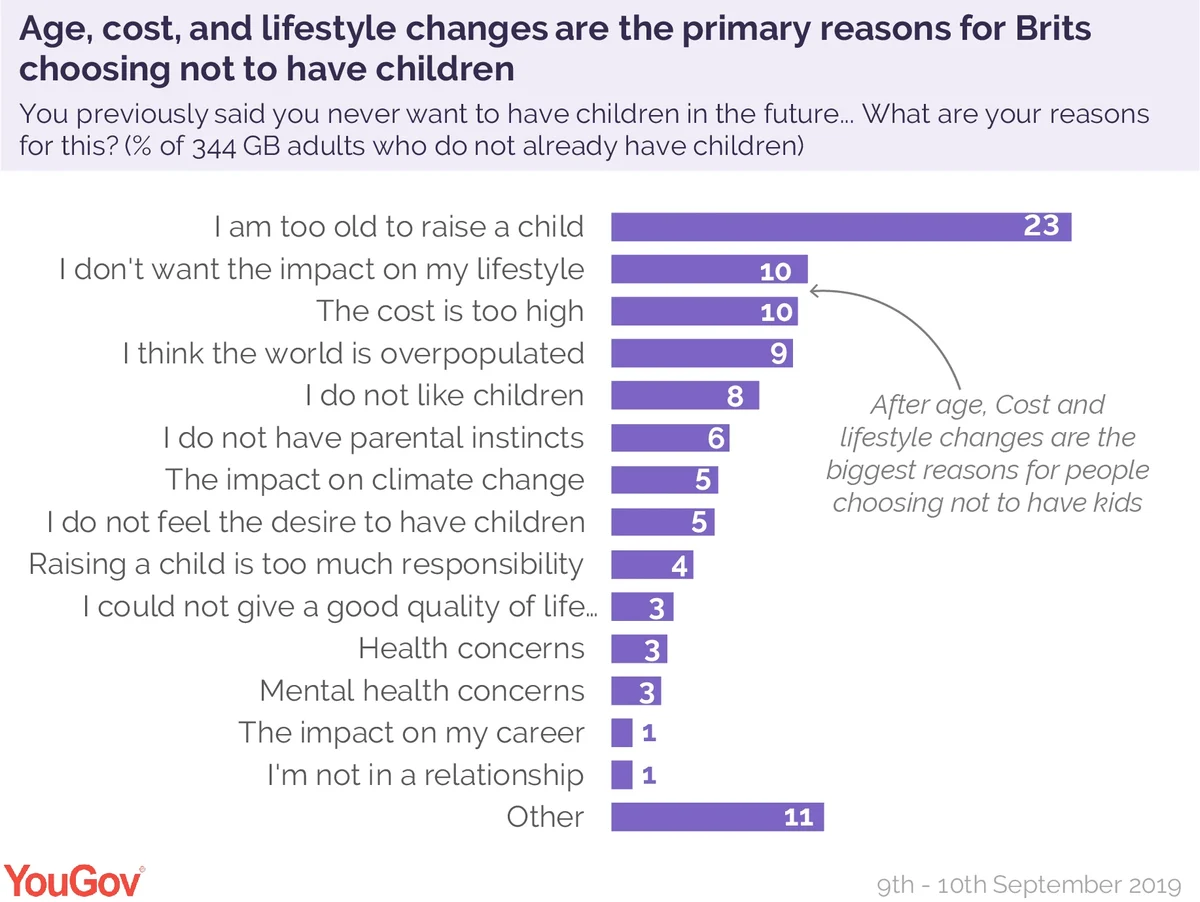
Now, why would people not make kids while they were young? They had no opportunity. Probably, they were forced to go to school, then work, maybe didn't have the chance to find a partner or didn't earn enough money for it to be possible before it was too late. All fixable things. So, the psychos should fix them before shoving people into more work which will only make them less likely to make kids. Most other reasons are similarly explained. Too high costs, well that one is obvious. Health and mental health are because of shit foods, shit environments, shit socializations, etc. Even impact on lifestyle, while it seems selfish, it's really just being realistic. We are not meant to go to work / school, then raise kids after that or have a nanny raise them, etc. There should be an extended family or village raising them at all times, and not everyone should need to have a job, so that it could happen. Also, kids should have more rights and opportunities in the first place so they wouldn't have to be "raised" so much. As will become obvious later, none of these problems the report is trying to fix - quite the opposite.
So you can't just learn one thing and earn your living
anymore - you need to be adaptable
AKA change on the fly when the winds of "the market" change. How stressful. But why not question the need to earn a living
in the first place, knowing how much is required from the worker these days?
It will only be the lost generation
if you psychopaths decide that it will be required of people to earn a living
in a world where that is no longer tenable.
Hahaha. Welfare savings
are the first target. Meaning shoving cripples into jobs so they can become more crippled and die. Also, what do you suggest will be the opportunities
in an age where automation is brutally wrecking the "job market"? The manipulation in this paragraph is disgusting. Presuming that shoving people into jobs at all costs is an opportunity
instead of pointless suffering. And that life chances
necessarily depend on whether you have a job. No mention, of course, about all the other places we could take the resources
from, such as all the ones going to Zelensky. Or for example, you could go after businesses doing fast fashion with billions of profits per year using strategies like Algorithm-driven trend identification via TikTok and Instagram
. Or all the other wastes of business such as the addictive game design which goads people into spending money on useless items, sometimes millions. Or the billions spent on sports stars' salaries which are themselves only possible because of unethical gambling companies (which generate 17.5 billions of profit per year) as well as pretending pro sports are not a doping party. So many sources if you just bothered to look instead of insisting on exterminating the disabled.
You utter morons. Do you realize what happens when you shove a slightly sick person into a job or school? They become more sick, eventually being unable to do anything at all. But all you can think of is to burden them instead of helping them.
I'm afraid that's what everyone does already. Give more, more tasks to the sick, which results in the ruinous consequence
of that person not being able to rest and heal but instead having to "fulfill the requirements" for daring to live. Because you psychopaths cannot deal with someone "just living" without justification...unless he's apart of the elite class, sustained by exploitation, of course.
Why do we need to eradicate NEETism? Why is full employment essential? You still haven't explained that and I suspect you won't.
Again that shit's been disproved already. Here is a poll that says "helping others" is one of the biggest predictors of feeling purposeful, and that a job doesn't help if it doesn't do that - and in 44% of cases (in this poll) it doesn't. In almost all countries, relationships come before occupations in terms of providing meaning. And again, if you look at what people on their deadbeds say, they regret working so much. Seems work is not that meaningful in hindsight.
NEET Zero
:D. Is this like "zero tolerance" in schools? A total failure in other words. Because it's going to be impossible due to automation killing jobs unless you make up really worthless ones just so that those damn NEETs can be tortured.
Leave disabled people alone, they need to rest and heal. You MONSTERS.
Okay, so, finally it is admitted schools are only supposed to prepare people for work later. It's not and has never been about education, socialization or character development at all like has been stated at times.
Yes it fucking should. The person needs to rest and fully heal before possibly undertaking a job. They should never be shoved into it or they'll fall apart. Just like sick school goers do.
Why. Must. Everyone. Work? It's almost the tenth of the report and you still haven't touched this.
Trapped on benefits
? Look at the manipulation once again. Why is it a trap, exactly? They don't have to do a shitty job, suffer and ruin their health further. That it's a trap is based on the assumption that everyone absolutely must justify their lives (again, aside from the psychos at the top who sit there and surely get paid a lot to write crap like this). Why is it never called a "trap" when a business sells its product at 10000% markup (such as the Covid vaccine companies)? This is literally a "benefit" - money earned without doing anything at all other than arbitrarily setting up the price so high. How about when advertising companies earn by shoving stuff we don't care about down our faces? Or when gambling companies siphon billions every year from desperate addicts who hope today will be their lucky day? When healthy executives want to get rich, it's just business or "enterpreneurship". On the other hand - when a sick person dares to live - it's a "benefits trap". Make it make sense (other than the psychos planning to exterminate the disabled).
Yeah they will be painful. So painful, in fact, that many will die. If you worry so much about the youth "building good lives", I recommend starting from ensuring that everyone has a place to live of his own. Then, that they are not thrown into the torture chamber known as school. You can fund this by taxing all the big evil companies at 90%, or don't let them earn anything by dishonest or expolitative means in the first place. This should also easily cover everyone's disability benefits. Hey, just thought I would help you since you seem to be flailing around :D.
Where will the 440000 additional jobs come from? Your reference says nothing about it.
Do you know what else is 13 billion? The "defense" (warmongering) money the psychopaths hope to find - He has also insisted he will call out Donald Trump when “it is in the British national interest” and is seeking ways to find the up to £13bn of cash needed to hit the UK’s target of 3 per cent of GDP on defence.
. And they will find it by sacrificing the disabled. Some of this "defense" money will reach psychopath Zelensky so that he can sacrifice the entirely of the male Ukrainian populace. This is why the entire scheme was cooked up in the first place. The psychopaths just needed money for war and the disabled are the perfect source for it since they are considered useless eaters by the so-called "elites".
You are assuming they are all able go to work. And that there are even jobs for them at all.
Yeah. And you chose warmongering. You chose space travel (More than 20 missions to put UK science at the heart of global action to better understand our Universe, from NASA’s James Webb Space Telescope to ESA’s Ariel spacecraft, which will help the search for life beyond Earth. More than 20 missions to put UK science at the heart of global action to better understand our Universe, from NASA’s James Webb Space Telescope to ESA’s Ariel spacecraft, which will help the search for life beyond Earth.
- do we really need this crap?), schools, and other useless crap. To help the most needy is the noblest use of money. If it's not done, then to me, "society" and the state might as well not exist at all.
Where is the proof for the savings? You still haven't shown where the jobs will come from. Or that all those people are even able to work without wrecking their health and making costs to sustain them higher in the end.
These 48% of people all shouldn't come anywhere near a job until their health improves enough so that they are not in danger of falling apart. Somehow, I doubt this scheme will lead to that.
Okay. We're up to over 20% of the report and we're still pretending everyone absolutely needs to work. Why?
Do you - psychopaths - have any obligations at all? You blew 10 billion on Zelensky like nothing.
So businesses will be paid to hire the young, then paid even more if they hire are disabled. But why? Why shove the disabled into work, and also spend money so that they suffer and degrade in health further? Why hire young parents, so that their kids have no one to care for them? WHY such obsession with making sure everyone works (this is still untouched...)?
That's a joke BTW. School teaches nothing useful for "jobs" (at least primary and secondary), other than the obedience required to endure work abuse later without a squeak. By the way, I've also read the entirety of UK gov school reform that's supposed to make it more "inclusive" - including for the disabled - and it completely fails there. There is basically nothing mentioned about how someone with CFS or other chronic disease is supposed to deal with school requirements. And this is how I know this scheme that's supposed to "help the disabled" will be a dud just the same. In fact, the parallels between the two are quite eerie; both seem to ONLY focus on whether the relevant sick person fulfills her (school or work) requirements - even if she falls apart or dies in the process.
It was already outdated at the time of its invention. 90+% of the stuff learned there is completely useless for jobs and will be forgotten. Someone could easily skip primary and secondary and just go to a trade school or take a course (barber or whatever) for his specific job and be more likely to land one than someone who then went to HS, then uni and got a useless degree and he's already old after all this. Just admit the education system is completely worthless and a waste of time and costs (which - if recovered - could also easily fund the disabled...).
Okay. So we are trashing geography, biology, history, foreign langs, and so on and just teaching agility and adaptability
in schools? Fine by me. But of course that's not what you mean (that would be too little torture for the plebeians). What you mean is that you can't tell a young person what she has to learn to survive. So you'll tell her to "somehow adapt" to the volatile winds of "the market". And yet, you are telling us you have some 440000 jobs prepared for the youngsters. You just can't tell us what those are, but surely there will be some! This is basically like giving a child an axe, and telling him "go cut these trees for me". He has zero experience and could cut himself or the tree could fall ON him. He could also be eaten by some predator out there (which you haven't taught him to deal with), but you don't care. The axe is there and your job is done and you can pretend you've given him all he needed.
Well they can't do any of that because of school. What are you going to do - eliminate it? Of course not.
How long is this myth going to persist? That you can just shove stuff into the kid and it will stick? Kids are not programmable machines. Just because you've called something "enriching", doesn't mean that's how it's actually going to end up inside the kid's brain.
Or maybe the things being measured are just worthless.
Oh fuck off. Another slavemaster treating kids like his personal Tamagotchis. Hasn't it been explained enough how social media bans RUIN any child that is abused by his parents and has nowhere to go IRL, that has unique interests, that is rejected by his IRL peers, that is TOO DISABLED TO LEAVE THE FUCKING HOUSE, and so on?
The teenager wants to play, explore, socialize, enjoy life - but instead is supposed to be preparing for work life. Work that might not even exist and this document certainly hasn't provided any examples yet of those 440000 jobs.
Or maybe they should be able to leave the torture chamber instead, if it's so boring to them that they stopped "engaging".
I hope this will at least be paid.
This sounds nice. But, is the point to actually help the sick people, or shove them into education or work ASAP? I suspect it's the latter and the report about UK schools' "inclusivity" (that I've talked about earlier) seems to support that.
See, I would really like to believe they want to do something for people with mental problems. But it just seems like a way to sweep them under the carpet so they can be shoved into a job (vocational rehabilitation
literally means "fixing" someone so they are able to work).
Once again, it seems like the autists will be forcibly shoved into a "normal" way of life instead of letting them live in a way that is adaptive to their condition.
See? I told you. It's not about helping people with mental issues, just shoving them into work ASAP. As usual, even though I've been around for so long and know exactly that diggy's razor (opposite of Hanlon's razor basically) effectively cuts things down, I still kept hope - and it got dashed away from me again. And let me bring this up again. We're through over 50% of the report, and it still hasn't been explained why everyone absolutely must work. My early prediction seems to be on track, and this point won't get touched at all.
Why not support people's mental health for its own sake, instead of so that they fulfill school or work requirements? Of course, that would require a reimagining of the entire "society", and it won't happen because that would hurt some powerful people and even many of the less powerful who love parental abuse, school obedience training, and so on. Truly, I don't believe "mental health support" the way it is traditionally envisioned (psychologists, drugs, therapy, and so on) even does anything. People have needs programmed by millions of years of evolution - and the current way of life doesn't fulfill those. Until that changes everything else are just coping mechanisms, bandages hoping to tape over the volcanoes in our bleeding hearts.
AI dystopia is coming. "Predicting" who is in danger of not fitting in and shoving, shoving him hard into the life he despises.
Help to navigate bullying
. Ha! Ha! Ha! You insuferrable buffoons. The only way to navigate bullying
is to get the fuck out of the torture chamber known as school, the only place where it regularly happens. This is just a way to blame the victim for the poisonous environment she found herself in, and assume it's something inevitable that she needs to learn to navitage
, instead of just leaving!
Can't you see how insane society has gotten if we need all these day-to-day support delivered
by mental health workers, youth workers, counsellors, crisis teams and peer
experts
just to endure it? Why does no one look at it from this angle?
Over and over it is being proven the gov just wants to shove sick people into work. So much that the system where a doctor decides who's capable of working and who's not, is planned to be replaced with one where unqualified "employment advisers" who know fuck all about disease, will decide it instead.
It's all so tiresome. I would like so much to believe we are ruled by normal people who sometimes make mistakes but want to do good in the end. But quotes like this throw that hope into the bin since it's clear they want to shove all disabled into the "perfect" path of suffering they envisioned. And of course, after 60% of the report, it still hasn't been explained WHY everyone must have a job.
FINALLY you bothered to tell us where the 440k additional jobs are supposed to come from. It's taking care of crippled boomers. But the logic is fragile. First of all, it assumes that everyone over the age of 65 needs a caretaker. And that there is a direct correlation between the amount of people aged 65+ and needed caretakers. Or that they won't just die earlier in the first place. Even so, recall that there is already a "missing" one million job spots, and more will be appearing due to automation (this they admit when they say they can't even tell a young person what skills will be needed in the future other than adaptability AKA being able to switch occupations quickly when your current one gets deprecated - or "adapt or die" ideology known as social darwinism). So even if those 400k caregiving jobs will truly be added, more will be lost from somewhere else, leaving the overall job spots less, and the scheme to shove everyone into a job still impossible. Oh, and of course, that prediction is for 2040 - where else are all those unemployed people supposed go before that?
HAHAHAHAHA. You wrote SO MUCH BULLSHIT to lead up to this. Lead up to what you truly want. Shove the kids into FUCKING UNPAID WORK!!! And then pretend it's great because it's a springboard or whatever. I'm fucking tired already of how shameless your psychopathy is. And you're so surprised only 6% of people want to sign up for this? It's fucking slavery. And it's supposed to be justified because it gives you skills or whatever. Hey, I'll let you work on my server if you think unpaid work is so valuable. It will give you the skills of sysadmining for the best page in the universe /s. While I won't have to keep swimming in useless Linux errors and recompiling everything because it's all getting ripped apart by AI assisted hacking :D. But of course, this psycho knows the score and he would never sign up for unpaid work himself, no matter what "later benefits" were promised to him.
Going after the mentally ill. Shameful.
2 billion? Is that it? That's 5 times less than you blew on Zelensky this year. All that torture...for nothing.
Let's recap. You shove all those sick people into jobs that might not even exist, possibly ruin their health, and in 7 years you only expect to earn 13.7 billion from it? That's barely more than you gave to Zelensky this year. And again, this is with the best assumptions. If those jobs don't appear or the people involved lose their health and incur additional costs, then it might even be less than that. So why not just cut the Zelensky handout instead and keep things as they are otherwise?
Ha! So the only way to keep being NEET in the UK will be to be so crippled as to be basically nonfunctional. Everyone else will be shoved into a job. For example, CFS sufferers don't require 24/7 hour care (usually). So they'll be made to work. As well as heart failure patients, cancer patients and so on that really should just be able to rest. With CFS in particular it is proven that any exertion makes these people worse. Yet, the psycho UK gov wants to shove them into a job so they fall apart and die. And there is no way they don't know - no one can be that stupid. It takes minutes to search for information about such diseases. This is a scheme for extermination.
So, some of the people who are currently receiving benefits will be shoved into a job instead...or at least, there will be an attempt. I wonder how will it be decided which needs are ongoing and long term
, too. Maybe like this:
It quickly became one of the most notorious images illustrating the cruelty and unreliability of the disability benefits assessment system: Smith had chronic obstructive pulmonary disease, osteoarthritis and an enlarged prostate that left him barely able to walk and in pain, but regardless he was found “fit for work” and told to look for a job.
It took a year for Smith’s benefits to be reinstated. To get them, at the end of last year the 64-year-old was forced to obtain a pass to discharge himself from hospital; ravaged with pneumonia, he had to leave his bed to attend a tribunal and fight his case.
Back to the report:
"If" it succeeds. You can't even provide examples of jobs that will be added other than speculative care jobs over a decade into the future. And of course, all the other sources of funding (like psychopath Zelensky's dreams of ravaging the entirety of Ukraine) are completely ignored still.
"Lost output" assumes everyone must work. We're almost 80% of the way to the end and it still hasn't been explained why? And, the entire reasoning is based on the assumption that productivity, or the amount of money moving, is everything that matters. But as I said, you can increase that in all kinds of evil ways like promoting gambling, addictive games, producing more war equipment, and so on.
All of this is still speculative. No way to prove how many jobs will be added and it's doubtful it will be more than the ones lost to automation. And there are too many missing spots already to bring down the NEET rate to the dreamed up 5%. Also, again, 3.6 billion is nothing in comparison to what's blown on warmongering or gambling or fast fashion, etc.
So? Once again, the most noble way to spend money is on the most needy. Somehow, it never comes up how much warmongering or gambling spending is increasing. And, shoving disabled people into work doesn't disable their disability suddenly. They will still be the same just suffering more and many will die. Just so the psycho gov can save some money on the people they despise the most.
How do you stop illness becoming a route into economic inactivity
? If someone is too sick too work, he's too sick, that is it. Unless you want him to fall apart and die. Which is what the psychos already admitted when they said the only way to be NEET will be to have either serious learning disabilities or need 24/7 care. Let this sink - if you are active for even one hour per day, you will be shoved into work. Even if the other 23 are spent sleeping or in pain, etc.
90% through and it still hasn't been explained why is shoving everyone into a job so important? And nice manipulation again, assuming that your schemes will necessarily "help" those people.
Your 10 year plan can't work. There is no way enough jobs will be added over that time period unless they are bullshit jobs. AI already ravaged math, art, programming, voice acting, music, military, teaching, and it's gunning for more. And there won't be enough spots for nurses to replace those, I'm afraid. So what your plan actually is, is the plan for mass sacrifice.
That's disingenous. Why not worry about the lost revenue from businesses that are not taxed enough? Why is there supposed to be increased health spending because of NEETs? Why not look at war spending if you want to save money?
It doesn't anymore, thanks to this plan, because the bar for disabled people to not have to work is supposed to be "very high".